
Summarize This Content with Artificial Intelligence (AI):
The exercise (treadmill) test is a key diagnostic method used to assess cardiovascular health by measuring how the heart functions during physical activity. Typically performed on a treadmill or stationary bicycle with gradually increasing intensity, this test helps identify existing heart or vascular problems as well as potential risks.
What Is an Exercise Test?
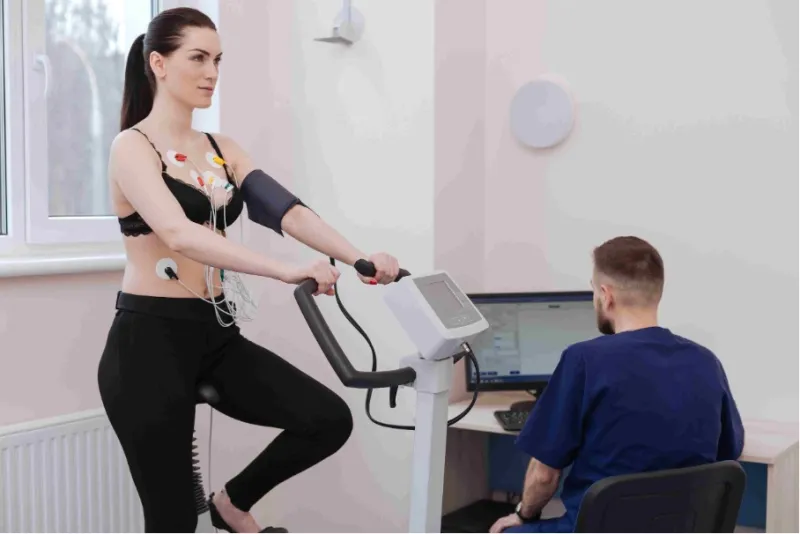
An exercise test, also known in medicine as an exercise stress test or treadmill test, measures the cardiovascular system’s response to physical exertion. During the test, the person is subjected to controlled physical stress while the electrical activity of the heart (ECG), heart rate, and blood pressure are monitored simultaneously.
The main goal is to determine whether the heart receives enough oxygen during exertion and to observe chest pain, arrhythmias, or blood pressure changes. The test also helps detect latent cardiovascular diseases that may only manifest when the heart is forced to work harder. For this reason, the exercise test is a highly valuable diagnostic tool in cardiology, both for risk assessment and for diagnosis.
Fill out the form to get information.
Types of Exercise Tests
Different types of exercise tests are performed depending on the patient’s age, health status, and physical ability. Some tests involve actual physical exertion, while others use medication to simulate stress on the heart. The most common types are:
- Treadmill Exercise Test (Cardiac Stress Test / Electrocardiogram Exercise Test)
This is the most widely used method. The patient walks on a treadmill or pedals on a stationary bike while heart rhythm, ECG, pulse, and blood pressure are recorded at regular intervals. The test usually follows the Bruce Protocol, in which the treadmill’s speed and incline increase every 3 minutes. - Myocardial Perfusion Scintigraphy (Nuclear Stress Test)
Also known as the thallium test, this method evaluates blood flow to the heart muscle. A radioactive tracer (such as Thallium-201 or Technetium-99m) is injected intravenously, and the heart is imaged during physical exercise or pharmacological stress. - Cardiopulmonary Exercise Test (CPET / VO₂ Max Test)
This test evaluates both cardiac and respiratory systems. The patient wears a mask, and oxygen consumption and carbon dioxide output are measured during exercise. - Stress Echocardiography
This combines an exercise test with echocardiography (heart ultrasound). The patient performs a treadmill exercise, and ultrasound images of the heart are taken before and after exercise to evaluate cardiac function. - Dobutamine Stress Echocardiography
For patients unable to exercise, a medication called dobutamine is used to increase heart rate and mimic exercise conditions. Ultrasound imaging is then used to assess cardiac performance under stress.
When Is an Exercise Test Recommended?
An exercise test is primarily performed to detect heart problems that occur during physical activity. However, it is also used for preventive or follow-up purposes. Common indications include:
- Chest pain or shortness of breath
- Suspicion of coronary artery disease
- Assessment after a previous heart attack
- Post-angioplasty or post-bypass surgery follow-up
- Arrhythmia (irregular heartbeat) evaluation
- Preoperative cardiac risk assessment
- Monitoring in patients with hypertension of unknown cause
- Routine screening in individuals at cardiovascular risk
- Fitness assessment in athletes
Who Can Have an Exercise Test?
The test can be performed both on individuals with symptoms and on those who are asymptomatic but have risk factors such as:
- Family history of early heart disease
- Smoking, high blood pressure, diabetes, obesity, high cholesterol
- Sedentary lifestyle or chronic stress
It can also be used to evaluate heart function in:
- Post-heart attack or post-bypass patients
- Those on long-term medication requiring exercise tolerance assessment
- Individuals preparing for major surgery
- Professional or amateur athletes
Preparation Before the Test
To ensure accurate results and minimize risk, the following preparations are recommended:
- Avoid eating for at least 2 hours before the test.
- Wear comfortable, athletic clothing.
- Inform your doctor about medications you use and any previous ECG results.
- Avoid caffeine (coffee, tea, energy drinks, cola).
- Men may need to shave chest hair to ensure proper electrode contact.
- Patients with hypertension or diabetes should take medications only under doctor supervision before the test.
How Is the Exercise Test Performed?
Before the test, a detailed cardiological examination is performed. Then, 10–12 electrodes are attached to the chest and connected to an ECG device. Resting ECG and blood pressure are recorded first. The test usually starts with walking on a treadmill following the Bruce Protocol, where both speed and incline increase every 3 minutes.
Throughout the test, ECG is continuously monitored, blood pressure and pulse are measured periodically, and symptoms such as chest pain, shortness of breath, or fatigue are noted. The test typically lasts about 15 minutes. Afterward, the patient rests while ECG monitoring continues for 5–10 minutes. The cardiologist then evaluates the results.
How Are the Results Interpreted?
Data obtained during the test—heart rhythm, blood pressure, heart rate, duration of exercise, and symptoms—are analyzed to assess cardiac performance and coronary risk.
- Positive Exercise Test: Suspicious or high-risk findings; further tests (angiography, scintigraphy, or stress echocardiography) are recommended.
- Negative Exercise Test: No abnormalities detected; cardiac function is normal.
- Inconclusive (Equivocal) Test: The result is unclear; additional diagnostic methods may be required.
When Is the Exercise Test Risky?
Although generally safe, the test is not recommended for individuals with:
- Recent (within 1 week) heart attack
- Severe arrhythmias
- Uncontrolled hypertension
- Severe aortic stenosis
- Uncontrolled heart failure
Frequently Asked Questions
How long does an exercise test take?
About 15 minutes, depending on the patient’s capacity.
Is the test different for women?
No, it is performed in the same way as for men.
What are normal values?
Heart rate (HR) should be 60–100 bpm; achieving ≥9 METs indicates good fitness.
What does a positive exercise test mean?
It indicates signs of coronary artery disease.
How to prepare for the test?
Wear comfortable clothes, eat a light meal 2–3 hours before, and inform your doctor about any medications.
What percentage of effort is required?
The target heart rate should reach at least 85% of the maximum, calculated as (220 − age) × 0.85.
Why does the doctor order an exercise test?
To evaluate chest pain, palpitations, or shortness of breath, and to detect coronary artery blockage or rhythm problems.
Is feeling tired during the test normal?
Yes, mild fatigue and sweating are expected; severe discomfort stops the test.
What is a MET in the exercise test?
MET (Metabolic Equivalent) measures exercise intensity. Higher MET values indicate better cardiovascular fitness.
Can rhythm disorders be detected?
Yes, arrhythmias occurring during exertion can be observed on ECG.
Can I smoke before the test?
No. Avoid smoking for at least 12 hours before, as it affects heart rate and test accuracy.
Do I need to shave before the test?
Yes, men should shave chest hair to ensure good electrode contact.
Creation Date:25.02.2026
Update Date:03.03.2026
Created by:Medipol Health Group Web Editorial Board