
Summarize This Content with Artificial Intelligence (AI):
Among the most detailed methods used to diagnose heart diseases, Cardiac MRI allows visualization of the heart’s structure in great detail. It is a non-invasive imaging technique that uses magnetic resonance and radiofrequency waves without any surgical incision.
What Is Cardiac MRI (Cardiac MR)?
Cardiac MRI (Magnetic Resonance Imaging of the Heart) is a non-invasive imaging method that uses magnetic fields and radiofrequency waves to produce detailed images of the heart and arteries. Cardiac MRI provides comprehensive information about the heart’s structure, function, and blood vessels, making it one of the most preferred diagnostic tools for heart disease detection and treatment planning. With cardiac MRI, doctors can evaluate all heart chambers, blood vessels, blood flow, heart valves, and the heart muscle.
Fill out the form to get information.
Which Diseases Can Be Diagnosed with Cardiac MRI?
Cardiac MRI is typically performed after initial tests such as blood analysis, ECG, echocardiography, and exercise testing to confirm or further investigate advanced heart conditions. It can be used to diagnose:
- Heart valve diseases (valve damage)
- Heart attack (myocardial infarction)
- Heart tumors
- Congenital heart diseases
- Pulmonary artery aneurysm (enlargement of the vessels carrying blood to the lungs)
- Aortic aneurysm (enlargement of the aorta)
- Heart failure
- Coronary artery disease
- Cardiomyopathy (heart muscle disorders)
- Pericarditis (inflammation of the heart membrane)
- Coronary vessel obstruction
How Is Cardiac MRI Performed?
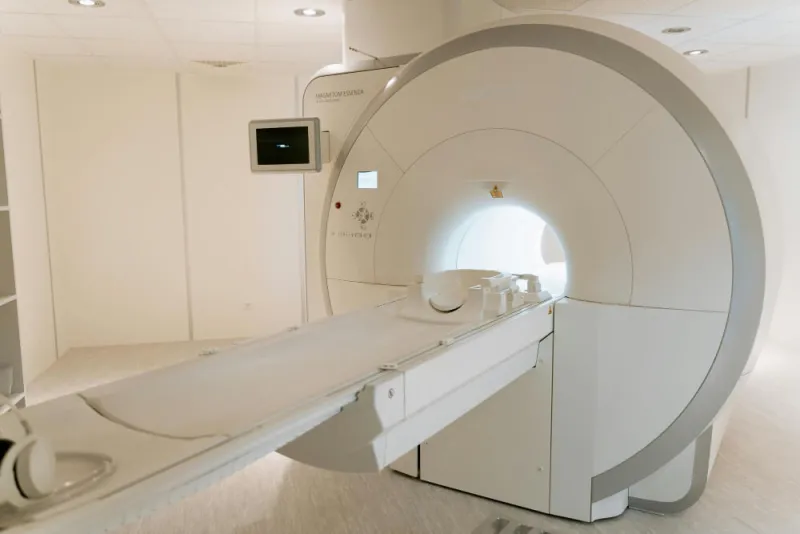
Cardiac MRI is performed by a radiologist in a specially equipped room. The patient lies down on a motorized table that slides into the MRI scanner. The patient must remain still throughout the procedure. The radiologist then leaves the room and monitors the process from a control area.
Once the scan begins, the MRI machine creates a strong magnetic field around the patient and directs radio waves toward the heart. During the scan, clicking or tapping sounds can be heard from the machine. The radiologist communicates with the patient through a built-in microphone and speaker system.
If a contrast-enhanced MRI is required, an intravenous (IV) line is inserted before the scan to administer the contrast agent. For patients with claustrophobia, a mild sedative may be given before the procedure. Cardiac MRI usually takes between 30 and 60 minutes, is non-invasive, and painless.
What Does Cardiac MRI Show?
Cardiac MRI provides detailed images of the heart’s structure and function. It allows evaluation of:
- Left and right ventricular mass (LVM, RVM)
- End-diastolic volume (EDV)
- End-systolic volume (ESV)
- Left and right ventricular size
- Ejection fraction (EF)
- Systolic wall thickening
- Myocardial motion
How to Prepare for Cardiac MRI
Before the procedure, the doctor should be informed about the patient’s complete medical history, including allergies, kidney disease, or claustrophobia. Preparation steps include:
- Removing all metal objects such as jewelry, piercings, belts, hearing aids, and metallic zippers or underwire bras.
- Continuing normal diet and medications unless otherwise instructed. Some cases may require fasting — this is determined by the physician.
- Emptying the bladder before the scan since the procedure is lengthy and requires the patient to stay still.
Are There Any Side Effects of Cardiac MRI?
Cardiac MRI has no known side effects. However, if a contrast agent is used, patients may experience mild allergic reactions or, in rare cases, difficulty excreting the contrast agent if they have kidney disease. Patients should always inform their cardiologist of any known allergies or kidney problems before the test.
Does Cardiac MRI Affect the Kidneys?
If the cardiologist requests a contrast-enhanced MRI, a gadolinium-based contrast agent is injected intravenously. In patients with kidney disease, contrast-enhanced scans are generally avoided because the contrast material may not be efficiently cleared from the body.
Before the scan, kidney function tests such as Glomerular Filtration Rate (GFR) and creatinine levels are checked. If GFR is low, contrast is not administered.
Frequently Asked Questions About Cardiac MRI
Types of Cardiac MRI
Cardiac MRI can be classified into two main types:
- Non-contrast MRI: Performed without administering a contrast agent.
- Contrast-enhanced MRI: Involves intravenous injection of gadolinium-based contrast material to obtain clearer images of the heart and vessels.
Is Contrast Agent Used in Every Cardiac MRI?
Not always. The cardiologist decides whether a contrast agent is necessary. Gadolinium-based contrast materials help improve image clarity but are usually avoided in patients with kidney disease.
How Long Does a Cardiac MRI Take?
The scan typically lasts 30–60 minutes, depending on the patient’s age, anxiety level, and the quality of the images. If the patient moves or becomes anxious, the procedure may take longer.
What Does “Cardiac” Mean?
The term cardiac comes from the Latin word cardiacus and medically refers to anything related to the heart — including diseases, procedures, or anatomical structures.
What Is a Cardiac Test?
Cardiac tests are procedures used to evaluate heart health and diagnose cardiovascular diseases. Common cardiac tests include:
- Electrocardiography (ECG)
- Echocardiography (ECHO)
- Exercise Stress Test
- Holter ECG
- Cardiac MRI
- CT Coronary Angiography
- Cardiac Enzyme Tests (blood tests)
- Myocardial Perfusion Scintigraphy (Heart Scintigraphy)
Is Cardiac MRI Risky?
Cardiac MRI is generally considered safe. However, it may not be suitable for patients with certain metallic implants or devices. The MRI machine creates a strong magnetic field that can interfere with or attract metal objects. Cardiac MRI may be risky for individuals with:
- Pacemakers
- Cochlear implants
- Intrauterine devices (IUDs)
- Old-type dental implants (modern titanium ones are safe)
- Old aneurysm clips in the brain
- Shrapnel or bullet fragments in the body
Who Should Not Undergo Cardiac MRI?
- Patients with pacemakers or MRI-incompatible implants
- Pregnant women (especially during the first trimester)
- Patients with severe claustrophobia (may be performed under sedation)
Can Pregnant Women Have a Cardiac MRI?
Cardiac MRI is not recommended during the first trimester of pregnancy unless absolutely necessary for the health of the mother or baby.
Should You Be Fasting for Cardiac MRI?
Fasting requirements depend on the cardiologist’s recommendation. Most cardiac MRIs are performed after light meals, but for stress cardiac MRI, fasting for 4–6 hours is usually required. It is also advised to avoid foods or drinks that increase heart rate on the day of the scan.
Post-Procedure Instructions
There are usually no restrictions after a cardiac MRI. However, if sedation was used, patients should rest until the medication wears off and avoid driving for 24 hours.
When Are Cardiac MRI Results Ready?
Results are typically available within one week, depending on the radiologist’s and cardiologist’s workload. The radiologist prepares the images, and the cardiologist analyzes and reports the findings.
Do You Need to Remove Clothes for the MRI?
Patients must remove all items containing metal, but full undressing is not always required. In some hospitals, patients may be asked to wear a hospital gown for safety and comfort.
Can MRI Be Done with a Stent?
Yes, if the stent is MRI-compatible. However, it is usually recommended to wait 6–8 weeks after stent placement before undergoing MRI.
Which Department Performs Cardiac MRI?
Cardiac MRI is requested by the cardiology department but performed in the radiology department by a radiologist.
Can Cardiac MRI Detect Coronary Artery Blockage?
Yes. Cardiac MRI can visualize coronary artery blockages and other structural or functional heart abnormalities. It is often used alongside ECG, ECHO, exercise tests, and blood work for a complete evaluation.
Where Is Cardiac MRI Available?
Cardiac MRI services are currently available only at Bağcılar Medipol MEGA University Hospital.
How Much Does Cardiac MRI Cost?
The cost of cardiac MRI varies depending on the hospital and location. For detailed information about pricing, please contact Medipol Hospital directly.
Creation Date:02.03.2026
Update Date:03.03.2026
Created by:Medipol Health Group Web Editorial Board