
Summarize This Content with Artificial Intelligence (AI):
Hydrocele is a congenital condition commonly seen in newborns, and if it does not resolve spontaneously by the age of two, it should be treated. In adults, hydrocele is usually caused by trauma, and if the accumulated fluid is not reabsorbed by the body within six months, it likewise requires treatment.
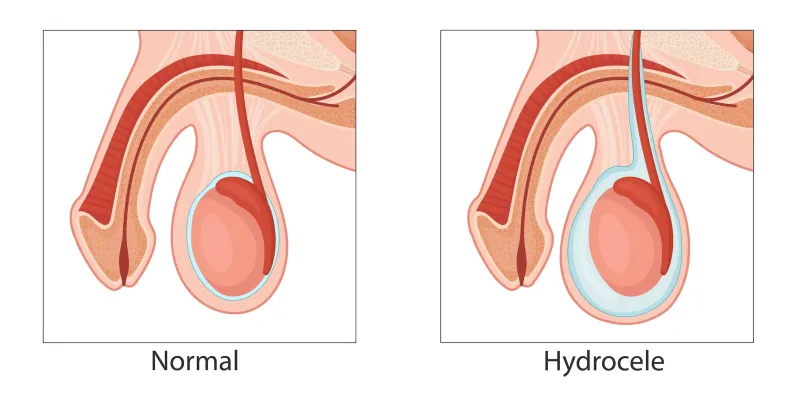
What Is A Hydrocele (Water Hernia)?
Swelling in the scrotum is caused by abnormal fluid accumulation and is more common in infants. Normally, the scrotum contains enough fluid to provide lubrication, but in hydrocele, the amount of fluid is greater, causing significant swelling. In hydrocele, fluid from the abdominal cavity usually accumulates in the scrotum. It can occur in adults and children as a result of any trauma.
What Are The Types Of Hydrocele (Water Hernia)?
Hydroceles are divided into different types depending on their causes. The types of hydrocele seen in newborn babies are as follows:
- Communicating hydrocele: The abdominal membrane descending into the scrotum (testicle sac) is open and remains connected to the fluid.
- Non-communicating hydrocele: After fluid accumulates in the scrotum, the abdominal lining closes and the scrotum fills with abdominal fluid.
- In adults, hydroceles usually occur as a result of trauma, infection, or certain specific health problems. Determining the type of hydrocele is important for treatment planning.
Fill out the form to get information.
What Are The Symptoms Of Hydrocele (Water Hernia)?
The most important symptom of hydrocele is unilateral (rarely bilateral) and painless swelling of the scrotum. As the swelling increases, the feeling of discomfort intensifies, and irritation may develop due to friction with clothing. Symptoms of hydrocele include:
- Scrotal swelling that changes in volume/size throughout the day.
- Discomfort in the scrotum
- A feeling of heaviness in the scrotum.
- In communicating hydrocele, pain increases as the amount of fluid increases.
What Causes Hydrocele (Water Hernia)?
Hydrocele is usually congenital. The baby's testicles are located inside the abdomen while in the womb, and as the baby develops, they descend into the scrotum, and the connection (processus vaginalis) closes. However, sometimes this connection may not close, and fluid begins to accumulate in the scrotum, or when the abdominal connection closes, the volume of fluid accumulating in the scrotum is excessive and remains stagnant, causing swelling. In infants, if the processus vaginalis has closed, the body usually absorbs and eliminates the fluid remaining in the scrotum within two years; therefore, intervention is usually delayed until the age of two.
How Is Hydrocele (Water Hernia) Diagnosed?
The diagnosis of hydrocele begins with a physical examination to check for swelling and pain in the scrotum. Transillumination testing may be preferred for diagnosing hydrocele. In a transillumination test, the doctor shines a light on the scrotum in a dark room to check if the swelling is filled with fluid. If the scrotum is translucent, it is likely a hydrocele, but if it is not translucent and the swelling is more opaque, it indicates another problem. Imaging methods such as ultrasound, as well as tests like urine and blood tests, are also used for diagnosis. Physical examination, transillumination test, and ultrasonography are sufficient for diagnosing hydrocele.
What Is The Treatment For Hydrocele (Water Hernia)?
Hydroceles usually resolve spontaneously within the first year in newborns and within six months of formation in adults. If a hydrocele does not heal, a surgical procedure called hydrocelectomy is performed to drain the fluid from the scrotum and close the opening between the processus vaginalis and the scrotum. There is no drug treatment that can cure hydrocele.
Is Hydrocele Preventable?
There is no way to prevent hydrocele formation in infants (newborns). Children and adults should protect their genital area, including the scrotum, from injury and trauma to prevent hydrocele.
Frequently Asked Questions About Hydrocele (Water Hernia)
What Happens If A Hydrocele Is Not Treated?
If the vaginal process is wide and left untreated, an inguinal hernia can occur. Inguinal hernia is a more painful problem and can be dangerous if it progresses.
What Happens If Hydrocele Is Not Treated With Surgery?
Hydroceles may resolve spontaneously within the first two years in newborns and within six months in adults, but if they do not resolve spontaneously, surgery is necessary.
Is Hydrocele Surgery Difficult?
Hydrocele surgery is an operation with a relatively low risk of complications and is a short procedure for an experienced surgeon. Complications such as infection, bleeding, and hematoma pose a risk for hydrocelectomy, as with any surgery.
Does Hydrocele Affect Sexuality?
A large hydrocele can cause discomfort during sexual activity due to the weight and discomfort it places on the scrotal area, and may negatively affect sexual performance, but a mild or moderate hydrocele does not directly affect sexual performance.
Does Hydrocele Cause Cancer?
Hydrocele is not a direct risk factor for cancer. However, if there is a tumor or mass in the scrotum that is accompanied by a hydrocele, the diagnosis may be delayed due to the hydrocele; the hydrocele may mask the tumor.
At What Age Does A Hydrocele Occur?
Water hernia is mostly congenital and occurs in newborns.
How To Drain A Hydrocele?
Hydrocele is treated with hydrocelectomy, a procedure in which the fluid is drained and the vaginal process is closed. Aspiration of the fluid with a needle without surgery can cause hydrocele to recur; therefore, permanent treatment is surgery.
Does Hydrocele Affect Fertility?
No, hydrocele does not cause infertility, but fertility rates may change if there is another serious underlying trauma or disease.
Does Hydrocele (Water Hernia) Cause Pain?
If the hydrocele is mild or moderate, it usually presents as a painless swelling, but if it is advanced, meaning there is excessive fluid accumulation, it can cause pain, discomfort, and a feeling of heaviness.
Creation Date:02.04.2026
Update Date:02.04.2026
Created by:Medipol Health Group Web Editorial Board