
Summarize This Content with Artificial Intelligence (AI):
An impacted tooth can remain dormant for years and may not cause pain; however, an impacted tooth that causes symptoms such as pain, abscess, and infection must be extracted through a surgical procedure.
What Is An Impacted Tooth?
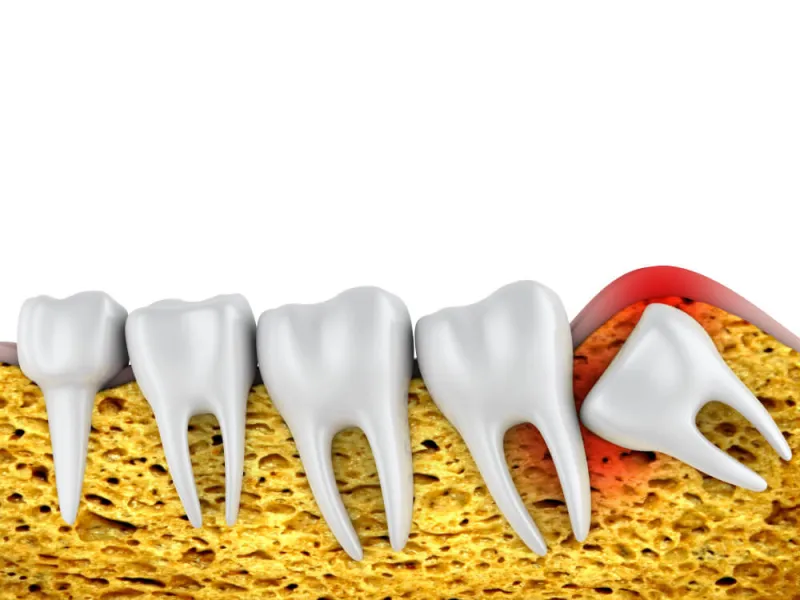
An impacted tooth is a tooth that cannot erupt properly through the gum into the mouth; it remains embedded in the gum or within the jawbone and sometimes becomes stuck and cannot emerge through the palate. Wisdom teeth are generally the ones that remain impacted; however, canine teeth can also remain impacted. Wisdom teeth remain impacted due to a lack of space in the jaw, the tooth remaining in an angled or horizontal position, or remaining embedded within the bone. An impacted tooth can persist in soft tissue, partially within the bone, or entirely within the jawbone.
Fill out the form to get information.
What Are The Types Of Impacted Teeth?
The types of impacted teeth are as follows:
Horizontally impacted tooth: These are teeth embedded horizontally that cannot emerge through the gum and generally cause crowding by pushing against adjacent teeth.
Vertically impacted tooth: These are teeth that cannot emerge through the gum but are positioned upright.
Mesially impacted tooth: This is the condition in which impacted teeth emerge toward the front of the mouth.
Distally impacted tooth: The direction of emergence of the impacted tooth is toward the throat rather than the mouth.
What Are The Symptoms Of An Impacted Tooth?
Some impacted teeth may continue to remain impacted without causing any symptoms; however, they can sometimes cause pain, swelling, infection, or bad odor. The symptoms of an impacted tooth vary from person to person and can be clearly visualized with a dental X-ray. The symptoms of an impacted tooth are as follows:
- Pain radiating as jaw, ear, or headache
- Pain during chewing or when opening the mouth or yawning
- Pain or sensitivity in the affected area
- Redness and swelling in the gums
- Infection around the impacted tooth
- Bad odor or bad breath due to infection
- Swelling of the lymph nodes
- Restriction in mouth opening (rarely)
- Pericoronitis (inflammation of the gums) due to food accumulating around a partially erupted impacted tooth
- High fever if infection or inflammation develops
Why Does An Impacted Tooth Occur?
The most common cause of an impacted tooth is the misdirected development of a wisdom tooth; however, hereditary causes, developmental problems, or insufficient space in the jawbone can also sometimes cause a tooth to remain impacted. The causes of impacted teeth are as follows:
- A crooked or misaligned tooth growing sideways or horizontally
- Insufficient space in the jawbone (if the jaw is small or there are too many teeth)
- Genetic factors and certain genetic diseases
Why Does An Impacted Canine Tooth Occur?
Although impacted teeth are most commonly seen in wisdom teeth, canine teeth also have a high likelihood of remaining impacted. Canine teeth are the last to develop and the last to erupt, and they can sometimes remain impacted. The causes of an impacted canine tooth are as follows:
- Insufficient space in the jaw (crowding of teeth in the upper jaw)
- Late shedding of the baby tooth (since the baby tooth has not shed, the canine tooth may erupt in the wrong direction or remain within the jaw)
- Genetic factors (jaw structure, tooth sizes, and directions of tooth eruption)
- Obstruction in the eruption path of teeth (extra teeth or teeth positioned at the wrong angle)
- Experiencing orthodontic problems during adolescence (crowded teeth, tooth excess, etc.)
How Is An Impacted Tooth Diagnosed?
For the diagnosis of an impacted tooth, the dentist first checks tooth sensitivity, infection status, and redness through a clinical examination. The diagnosis of an impacted tooth is made with a panoramic dental X-ray. The lower jaw and upper jaw are clearly visualized in a panoramic dental X-ray, and impacted teeth within the jawbone are also visible. If the impacted tooth is to be examined in more detail, cone beam computed tomography (CBCT) may be requested. Cone beam computed tomography (CBCT) shows the position of the tooth, the neighboring nerves of the roots, and the anatomical structure in three dimensions.
What Is The Treatment For An Impacted Tooth?
The treatment of an impacted tooth varies depending on the case. An impacted tooth that is painless and does not cause symptoms is monitored with regular checkups. If the impacted tooth causes symptoms such as pain, infection, tooth decay, damage to the jawbone, or damage to adjacent teeth, extraction is required. An impacted tooth is generally removed through a surgical procedure. Surgical extraction is a procedure performed under local anesthesia, during which an incision is made in the gums to expose the bone and, if necessary, the tooth is removed in pieces. Antibiotics and painkillers may be prescribed after the procedure, and a follow-up examination is planned against the risk of complications.
What Should Be Paid Attention To After Impacted Tooth Extraction?
There are some methods that can be applied to promote healing and reduce complications after impacted tooth extraction. The points to be paid attention to after impacted tooth extraction are as follows:
- Forceful spitting or swallowing movements should be avoided for the first 24 hours.
- Gargling should not be done for the first 24 hours.
- Hot food and beverages should not be consumed for the first 24 to 48 hours.
- An ice compress should be applied externally to the area where the procedure was performed at 30-minute intervals.
- It is beneficial to rest and sleep if possible with the head elevated.
- Pressure can be applied with sterile gauze to control bleeding in the first few days.
- The prescribed painkillers and antibiotics should be used regularly.
- Smoking should be avoided for at least 72 hours.
Frequently Asked Questions About Impacted Teeth
Can An Impacted Tooth Emerge On Its Own?
Some impacted teeth emerge on their own over time; however, tooth extraction should be planned for an impacted tooth that begins to cause symptoms such as pain, sensitivity, and infection.
What Happens If An Impacted Tooth Is Not Extracted?
If an impacted tooth is not extracted, it can cause complications such as the following:
- Pericoronitis (gum inflammation)
- Chronic infection
- Abscess
- Decay in adjacent teeth or damage to adjacent teeth
- Cyst formation
- Rarely, tumor-like lesions
Is a Painless Impacted Tooth Harmful?
Being painless does not mean the impacted tooth is harmless. Complications can develop over the years. Even if painless, an impacted tooth should be monitored with regular checkups and X-rays.
Is Impacted Tooth Surgery Difficult?
The difficulty of impacted tooth surgery depends on factors such as the position of the tooth, the degree of impaction, the number of roots, root curvature, the size of the tooth, and the patient's general health. In impacted teeth in the lower jaw, the difficulty of surgery may increase due to the mandibular nerve.
When Are The Stitches Removed After Impacted Tooth Surgery?
Stitches after impacted tooth surgery are generally removed at the end of 1 week; however, the duration may extend depending on complications and the difficulty of the procedure. Early removal of stitches can cause the wound to open, while late removal can cause irritation around the stitches.
Can There Be An Impacted Tooth in the Upper Palate?
Yes, there can also be an impacted tooth in the upper palate. Due to its proximity to the sinus cavity, surgery for an impacted tooth in the upper jaw carries different risks compared to lower jaw surgery.
How Is An Impacted Canine Tooth Treated?
In the treatment of an impacted canine tooth, the aim is to bring the impacted canine teeth into the mouth. Orthodontic guidance is performed through braces (brackets); however, if the tooth is completely impacted, the gums must be opened through a surgical procedure.
How Many Days Does It Take For An Impacted Tooth Extraction To Heal?
An impacted tooth extraction generally heals completely within 4 to 6 weeks, and the surrounding tissues in the mouth return to normal.
Does An Impacted Tooth Cause Bad Odor?
Yes, it can cause problems such as bad breath due to bacteria, food particles, and infection accumulating around the impacted tooth.
Where Does An Impacted Tooth Cause Pain?
If the impacted tooth is in the lower jaw, it causes pain that radiates to the lower part of the jaw and sometimes to the ear. If the impacted tooth is in the upper jaw, it causes pain that radiates to the cheek and skull region.
Can An Impacted Tooth Decay?
Yes, impacted teeth can decay. Partially erupted impacted teeth have a higher likelihood of decay; however, a tooth completely embedded within the bone can also be affected by decay in adjacent teeth and decay, even if it has no contact with the external environment.
How Should One Eat After Impacted Tooth Surgery?
Hot or cold foods should not be consumed in the first 24 hours after the procedure, and chewing movements that will tire the jaw should be avoided. It is recommended to eat after the period advised by the doctor.
Creation Date:17.04.2026
Update Date:17.04.2026
Created by:Medipol Health Group Web Editorial Board