
CT Virtual Angiography
CT virtual angiography is an imaging method that provides detailed visualization of blood vessels.
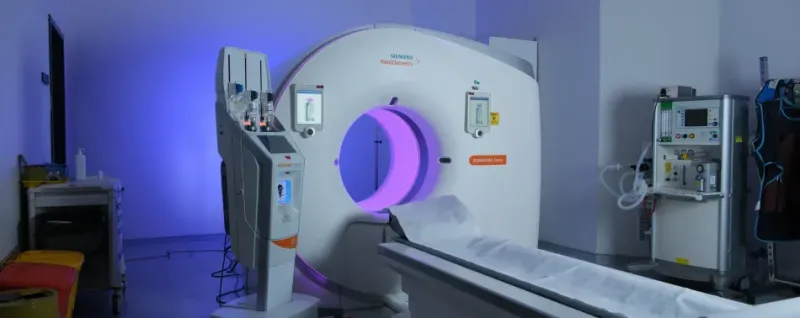
CT Virtual Angiography
CT virtual angiography is an imaging method that provides detailed visualization of blood vessels. Painless and non-invasive (performed without entering the body), the procedure is completed quickly and does not require a hospital stay. The images obtained with the help of computed tomography (CT) are evaluated by specialist physicians to detect potential vascular problems. It is particularly important for early diagnosis in patients at risk of cardiovascular disease.
What is CT Virtual Angiography?
CT virtual angiography is an advanced diagnostic method used to obtain detailed images of the coronary arteries that supply the heart. During the procedure, a special contrast agent (dye) is administered intravenously, and three-dimensional images of the blood vessels are obtained with the help of CT.
Unlike traditional angiography, this non-invasive method does not require catheter insertion into the vessels. It can be used to evaluate not only the heart vessels but also the vessels of the brain, lungs, kidneys, arms, and legs. Virtual angiography, which can be performed in just a few minutes, allows the patient to return to normal daily activities on the same day, increasing patient comfort and accelerating the diagnostic process.
CT virtual angiography can be used not only to detect existing problems but also for early diagnosis in individuals at risk. Blood vessels can be thoroughly examined in people with a family history of cardiovascular disease or those with conditions such as diabetes or hypertension, allowing potential problems to be identified early.
What Conditions is CT Virtual Angiography Used to Detect?
CT virtual angiography can be used to detect a wide range of conditions in which the structure of blood vessels is altered or blood flow is affected. The main conditions for which CT virtual angiography is used include:
- Coronary artery disease (narrowing or blockage of heart vessels)
- Cerebral vascular diseases (aneurysm, arteriovenous malformation, narrowing, clot, stroke, brain hemorrhage)
- Pulmonary embolism (blood clot in the lungs)
- Aortic diseases (aneurysm, rupture)
- Peripheral artery disease (narrowing of arteries in the arms and legs)
- Congenital vascular anomalies
- Tumors
CT virtual angiography enables the early detection of life-threatening conditions, ranging from heart attacks and strokes to pulmonary clots and major vessel ruptures. Early diagnosis allows timely treatment and effective intervention in these diseases.
What are the Advantages and Disadvantages of CT Virtual Angiography?
CT virtual angiography is an advanced imaging method that allows rapid and detailed examination of blood vessels. Like any medical procedure, it has both advantages and some limitations.
Advantages:
- Non-invasive: No catheter insertion into the vessels is required, unlike conventional angiography, so surgical intervention is not necessary.
- Painless and comfortable for the patient.
- Fast and detailed results are obtained.
- Provides three-dimensional imaging of the vascular structure.
- Allows early diagnosis, which can help prevent diseases.
- High-resolution imaging is provided.
Disadvantages / Limitations:
- Exposure to a minimal level of radiation.
- Not suitable for pregnant patients.
- The contrast agent administered intravenously may cause allergic reactions in some individuals.
The contrast agent may also affect kidney function in certain patients.
Factors such as potential allergic reactions to the contrast agent or radiation exposure must be carefully considered for each patient. During pre-procedure consultations, your doctor will provide detailed.
Who is CT Virtual Angiography Suitable For?
CT virtual angiography helps in diagnosis both for patients with existing symptoms and for individuals in high-risk groups. It is particularly important for risk assessment in people with a family history of heart disease or with health conditions such as hypertension and high cholesterol.
CT virtual angiography may be suitable in the following cases:
- Individuals at risk for cardiovascular disease
- People with a family history of heart disease
- Individuals suspected of having an aneurysm or arteriovenous malformation (AVM)
- People experiencing chest pain or shortness of breath
- Patients for whom conventional angiography is not suitable
- Individuals with diabetes, hypertension, or high cholesterol
Preparations Before CT Virtual Angiography
To achieve the best results, certain preparations should be made before undergoing CT virtual angiography. These preparations include:
- A detailed examination is performed before the procedure to assess the patient’s existing medical conditions, medications, and complaints.
- Comfortable and loose-fitting clothing should be worn, and metal objects such as jewelry, glasses, and hairpins should be removed.
- Patients may be asked not to eat or drink for several hours prior to the procedure.
- If the patient has a known allergy to the contrast agent, the doctor may instruct taking prescribed medication before the procedure.
- Medications such as blood thinners may be temporarily paused prior to the scan.
Proper preparation before CT virtual angiography not only improves image quality but also helps prevent potential risks. It is essential to provide your doctor with complete information about your medical conditions, medications, and allergy history before the procedure.
Post-Procedure Care for CT Virtual Angiography
After CT virtual angiography, certain precautions should be taken to minimize potential side effects. The main points to keep in mind are:
- Drink plenty of water after the procedure to help flush the iodine-based contrast agent from the kidneys.
- Rest for a few hours after the procedure. Although patients can usually return to daily activities the same day, they should avoid overexertion.
- Medications that were paused before the procedure can be resumed based on your doctor’s instructions.
- Monitor for signs of allergic reactions, such as itching or shortness of breath, and inform your doctor immediately if they occur.
The post-procedure period is generally smooth and comfortable. Follow your doctor’s recommendations before and after the procedure, and contact your doctor promptly if any concerns arise.
Frequently Asked Questions About CT Virtual Angiography
How Long Does the CT Virtual Angiography Procedure Take?
The procedure is quite short and is usually completed within 10–15 minutes.
Are There Any Risks With CT Virtual Angiography?
The procedure is generally safe, but there may be risks related to radiation exposure, allergic reactions to the contrast agent, or kidney function.
When Will the CT Virtual Angiography Report Be Ready?
After the images are evaluated by a radiology specialist, the report is typically issued within 1–3 business days.
How Much Does CT Virtual Angiography Cost?
The cost of CT virtual angiography may vary depending on the areas being examined and insurance coverage. For the most accurate pricing, you can contact the Medipol Health Group.
Other Featured Technologies
- Halcyon
- 150 Watt Holmium Laser Energy
- 16-Slice Computed Tomography (CT)
- 256 Slice Computed Tomography (256 Slice CT)
- 3.0 Tesla Magnetic Resonance Imaging (3.0 T MRI)
- Amyloid PET CT
- Anymov Robotic Bed System
- Armeo Power Hand and Arm Robot
- Artis Zee
- Artis Zee Ceiling Eco
- Biodex Balance Training System
- Biograph mCT
- Biplane Digital Flat Detector Angiography System
- Bone Densitometer
- Bone Scintigraphy
- Brachytherapy
- Cardiac Spect
- Cardiac Ultrasound
- Cios Select
- CyberKnife M6
- Digital Flat Panel Mammography with Spectral Tomosynthesis
- Digital Mammography
- Doppler Radiological Color 4D Ultrasound (USG)
- Dual-Energy CT
- ESWL
- Flexible Ureterorenoscopy (FURS) with the Clear Petra System
- Flexible Ureteroscopy
- Gamma Knife
- HIFU (High Intensity Focused Ultrasound)
- Intensity-Modulated Radiation Therapy (IMRT)
- Intra-Operative MR
- IntraBeam (ZEISS)
- Lokomat Robotic Walking System
- Luminos Fusion
- MAGNETOM Sola
- MAGNETOM Vida
- MAMMOMAT Revelation
- Monalisa Touch Laser
- Mono-Plan Cardiac Angiography
- Monoplane Digital Flat Detector Cardiac Angiography System
- MR Elastography of Liver
- MR Fusion Prostate Biopsy
- MRgFUS (MR Guided Focused Ultrasound)
- MRI Under General Anesthesia
- Multix Fusion Max
- Multix Impact
- Multix Select DR
- O-ARM Perop CT Imaging System
- PET CT
- Polymobil Plus
- Prostate Surgery With HoLEP Method
- Radiotherapy
- Real Time 4D USG Voluson E8 Expert
- Robotic Heart Surgery: Heart Surgery with Robotic Assistance
- Robotic Kidney Surgery
- Robotic Surgery
- Robotic Surgery for the Treatment of Sleep Apnea
- Robotic Surgery in Prostate Cancer
- Robotic Urology
- Smile Pro Laser
- SOMATOM Force Computed Tomography System
- SOMATOM go.All
- SOMATOM Perspective
- SPECT/CT
- StealthStation Surgical Navigation Systems
- Symbia Evo Excel
- The Use and Advantages of Robotic Surgery in Gynecology
- Use of Robotic Surgery in Ear, Nose, and Throat (ENT) Diseases
- Varian Truebeam
- What is Robotic Hip Replacement Surgery and How is it Performed?
- What is Robotic Knee Replacement Surgery and How is it Performed?
- What is Robotic Obesity Surgery, and Who is it Suitable For?
- Zeiss Artevo 800 Digital Microscope
Creation Date:30.01.2026
Update Date:30.01.2026
Created by:Medipol Health Group Web Editorial Board