
Robotic Urology
Robotic urological surgery is a minimally invasive surgical method performed through small incisions using advanced robotic technologies.
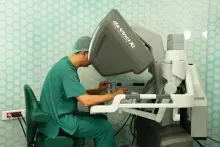
Robotic urology is a modern branch of medicine that uses robot-assisted surgical techniques in the treatment of urological diseases. Thanks to minimally invasive methods, robotic surgery, performed through small incisions, offers more precise, safer, and faster recovery processes in complex urological operations such as prostate cancer, kidney tumors, and bladder surgery.
What is Robotic Urology?
Robotic urological surgery allows the surgeon to perform the operation with greater control and precision through an advanced system. The surgeon controls the robotic arms via a console and uses special surgical instruments attached to these arms.
Robotic surgery is most frequently applied in the field of urology to treat oncological diseases such as prostate cancer, kidney cancer, and bladder cancer. It is also effectively used in the repair of urological problems such as renal duct strictures.
In urology, robot-assisted surgery is preferred, especially in complex operations, and offers significant advantages to patients. Compared to traditional surgical methods, this technique shortens recovery time and reduces the risk of complications.
Fill out the form to get information.
How is Robotic Urology Performed?
During the surgery, robotic arms are inserted through small incisions made in the abdominal area. The surgeon sits in a special area called a console and controls the robotic arms. The robot instantly transmits the surgeon's hand movements and performs the procedures to be applied to the tissue with high precision.
Thanks to high-resolution 3D imaging and flexible robotic arms, anatomical structures can be seen more clearly. This makes it easier to protect the structures that enable urinary continence and the nerves involved in erectile function, especially in prostate cancer surgeries. Thus, urinary incontinence and erectile dysfunction are less common after surgery.
Thanks to the advantages provided by robotic surgery, such as small incisions, less blood loss, shorter hospital stays, and faster recovery, patients experience the surgery more comfortably and can return to their daily lives sooner.
Why Choose Robotic Urology?
The mobility offered by robotic systems allows for turns and angles that the human hand cannot achieve. This enables highly precise procedures even in confined areas of the body.
The Areas Of Application For Urological Robotic Surgery
In urological robotic surgery, this minimally invasive method, performed through small incisions, provides high precision and short recovery times, especially in the treatment of prostate cancer, kidney tumors, bladder surgery, and urinary tract strictures.
The areas of application for urological robotic surgery are listed below:
- Prostate cancer surgeries
- Kidney cancer surgery
- Bladder cancer surgeries
- Ureteropelvic junction strictures
- Kidney and ureter stone surgeries (in selected cases)
- Intracorporeal (intrabody) bladder production
- Pelvic floor surgeries
- Recurrent urological surgeries
Which hospitals offer robotic urological surgery?
In the field of urological surgery, robotic methods accelerate the healing process and reduce the risk of complications thanks to their minimally invasive approach. In this context, Medipol Mega University Hospital and MEDIPOL Acıbadem District Hospital are among the centers offering robotic urology services.
Other Featured Technologies
- Halcyon
- 150 Watt Holmium Laser Energy
- 16-Slice Computed Tomography (CT)
- 256 Slice Computed Tomography (256 Slice CT)
- 3.0 Tesla Magnetic Resonance Imaging (3.0 T MRI)
- Amyloid PET CT
- Anymov Robotic Bed System
- Armeo Power Hand and Arm Robot
- Artis Zee
- Artis Zee Ceiling Eco
- Biodex Balance Training System
- Biograph mCT
- Biplane Digital Flat Detector Angiography System
- Bone Densitometer
- Bone Scintigraphy
- Brachytherapy
- Cardiac Spect
- Cardiac Ultrasound
- Cios Select
- CT Virtual Angiography
- CyberKnife M6
- Digital Flat Panel Mammography with Spectral Tomosynthesis
- Digital Mammography
- Doppler Radiological Color 4D Ultrasound (USG)
- Dual-Energy CT
- ESWL
- Flexible Ureterorenoscopy (FURS) with the Clear Petra System
- Flexible Ureteroscopy
- Gamma Knife
- HIFU (High Intensity Focused Ultrasound)
- Intensity-Modulated Radiation Therapy (IMRT)
- Intra-Operative MR
- IntraBeam (ZEISS)
- Lokomat Robotic Walking System
- Luminos Fusion
- MAGNETOM Sola
- MAGNETOM Vida
- MAMMOMAT Revelation
- Monalisa Touch Laser
- Mono-Plan Cardiac Angiography
- Monoplane Digital Flat Detector Cardiac Angiography System
- MR Elastography of Liver
- MR Fusion Prostate Biopsy
- MRgFUS (MR Guided Focused Ultrasound)
- MRI Under General Anesthesia
- Multix Fusion Max
- Multix Impact
- Multix Select DR
- O-ARM Perop CT Imaging System
- PET CT
- Polymobil Plus
- Prostate Surgery With HoLEP Method
- Radiotherapy
- Real Time 4D USG Voluson E8 Expert
- Robotic Heart Surgery: Heart Surgery with Robotic Assistance
- Robotic Kidney Surgery
- Robotic Surgery
- Robotic Surgery for the Treatment of Sleep Apnea
- Robotic Surgery in Prostate Cancer
- Smile Pro Laser
- SOMATOM Force Computed Tomography System
- SOMATOM go.All
- SOMATOM Perspective
- SPECT/CT
- StealthStation Surgical Navigation Systems
- Symbia Evo Excel
- The Use and Advantages of Robotic Surgery in Gynecology
- Use of Robotic Surgery in Ear, Nose, and Throat (ENT) Diseases
- Varian Truebeam
- What is Robotic Hip Replacement Surgery and How is it Performed?
- What is Robotic Knee Replacement Surgery and How is it Performed?
- What is Robotic Obesity Surgery, and Who is it Suitable For?
- Zeiss Artevo 800 Digital Microscope
Creation Date:27.03.2026
Update Date:27.03.2026
Created by:Medipol Health Group Web Editorial Board